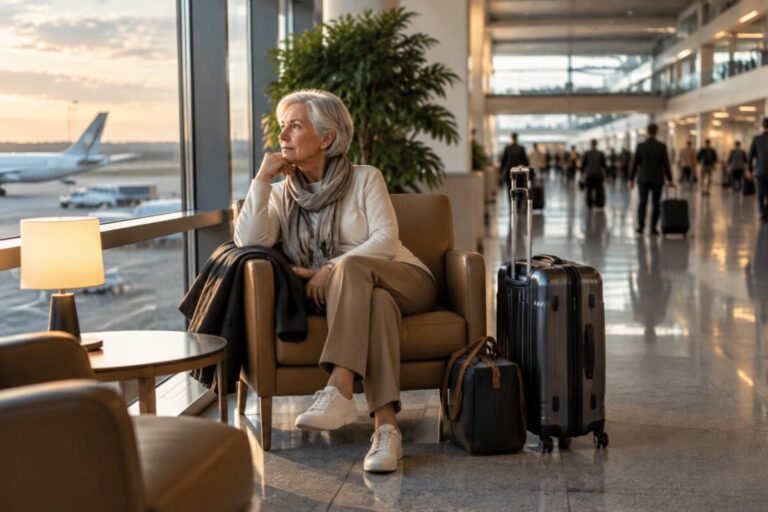
Senior mobility: walking while carrying too much, an ordinary but real danger
Hello, Lucien here.
Walking with a load that’s too heavy can throw off your stride and increase the risk of falling: lighten what you’re carrying and keep your hands free.
When traveling, a few bags often seem harmless. But fatigue, an uneven sidewalk or an unexpected step can turn this extra load into a real safety issue.
Simple ways to walk with a lighter load
- Distribute the weight in a well-adjusted backpack rather than carrying a bag on one side.
- Keep one hand free to hold a handrail or use a mobility aid.
- Lighten what you carry and leave nonessential items at your accommodation.
- Take breaks as soon as fatigue or pain changes the way you walk.
- Use a suitable trolley or public transportation if the route is long or the load is still cumbersome.
A load pulling on your shoulder can affect your balance and make you compensate with every step. To better manage your effort while traveling, see these tips on physical exertion while traveling and precautions to help prevent a fall on the way back from an outing.
Why carrying too much becomes a real risk
Carrying a heavy or unbalanced bag puts more strain on your back and shoulders. At the same time, your arms are less available to help you steady yourself if the ground is slippery or an obstacle appears.
The danger increases when several factors come together: fatigue, unstable footwear, joint pain or already-fragile balance. Prevention therefore starts before you leave, when you decide what you really need to keep within reach.
A simple example during an outing
Jeanne, 76, sets off to visit a market with a handbag and a shopping bag loaded with bottles. After a few streets, the shopping bag pulls on her arm, and she struggles to keep her balance on uneven paving stones.
By leaving her purchases at her accommodation and taking a small, well-adjusted backpack, she gets back to walking more naturally. The goal isn’t to give up the outing, but to avoid letting the weight dictate the pace.
Choose a solution suited to the load
A well-adjusted backpack distributes weight better than carrying a load on one side, but it isn’t right for everyone. If putting it on or taking it off causes painful effort, it’s best to ask a healthcare professional for advice or choose another option.
A cane or walker shouldn’t be used to compensate for a load that’s too heavy. These aids are designed to support walking: loading them up or keeping one hand occupied can make them less useful and compromise safety.
| Situation | Recommended solution | What to watch out for |
|---|---|---|
| Small load, steady walking | Light bag carried close to the body | Make sure it doesn’t swing with every step |
| Heavier load | Distribute your belongings or use an easy-to-maneuver trolley | Make sure the trolley doesn’t get in the way of walking |
| Fragile balance or fatigue | Shorten the route and ask for help | Don’t carry a load while using a mobility aid |
| Pain or unusual weakness | Stop and seek medical advice if needed | Don’t push yourself to finish the route |
The right choice depends on your strength, balance and the terrain. At a train station or a large airport, asking for assistance can save you from carrying your luggage over a long distance.
Three steps to protect your mobility as you age
- Before you leave: Make a short list, remove unnecessary items and test the bag’s weight over a few steps.
- During the journey: Keep your hands free as much as possible, slow down on uneven surfaces and take a break if the way you walk changes.
- If the load is still difficult to manage: Ask someone close to you to carry it, use a luggage transport service or request suitable assistance.
If you experience new pain, dizziness or a loss of balance, put the load down and stop somewhere safe. Unusual fatigue that persists also warrants medical advice: it’s better to adapt the outing than risk a fall.
Practical questions about walking with luggage
Why can walking with too much weight make you lose your balance?
A heavy load or one carried on one side changes your posture and puts more strain on your muscles. It can also make it harder to catch yourself if you stumble.
Is a backpack always better than a handbag?
It generally distributes weight better, provided it is light and properly adjusted. If putting it on or taking it off is difficult, choose another option and ask for advice if needed.
What should you do if you get tired while walking?
Stop somewhere safe, put the load down and rest. Then shorten the route or use transportation rather than pushing yourself to continue.
Can you carry a bag while using a cane or walker?
This can interfere with using the aid and reduce stability. Choose a light bag that doesn’t occupy your hands, or ask for help carrying your belongings.
Thanks for reading! Feel free to share your observations in the comments. — Lucien